Imagine you want to place a futures trade on BTC while also earning yield on idle ETH — and you need to do it quickly, securely, and in a way that won’t blow up your account if volatility spikes. That practical scenario forces three immediate questions: how do you get into OKX safely from the U.S., what are the real mechanics behind spot, margin and futures on the platform, and where do common intuitions break down? This article walks through those mechanics, corrects frequent misconceptions, and gives decision-useful rules of thumb for U.S.-based traders.
Start with the login step: for many traders the access path is not just a convenience issue but the hinge on safety. OKX supports a web platform, mobile apps with biometric login, and a browser extension wallet. U.S. users must complete KYC (government ID + facial liveness) before full feature access; two-factor authentication is mandatory. If you’re logging in from a public connection or a new device, the exchange’s AI-driven threat detection may trigger additional verification — not a bug, but a protective friction. If you want to access the web interface quickly, use the official route to okx sign in and then enable hardware-based or app-based 2FA immediately.
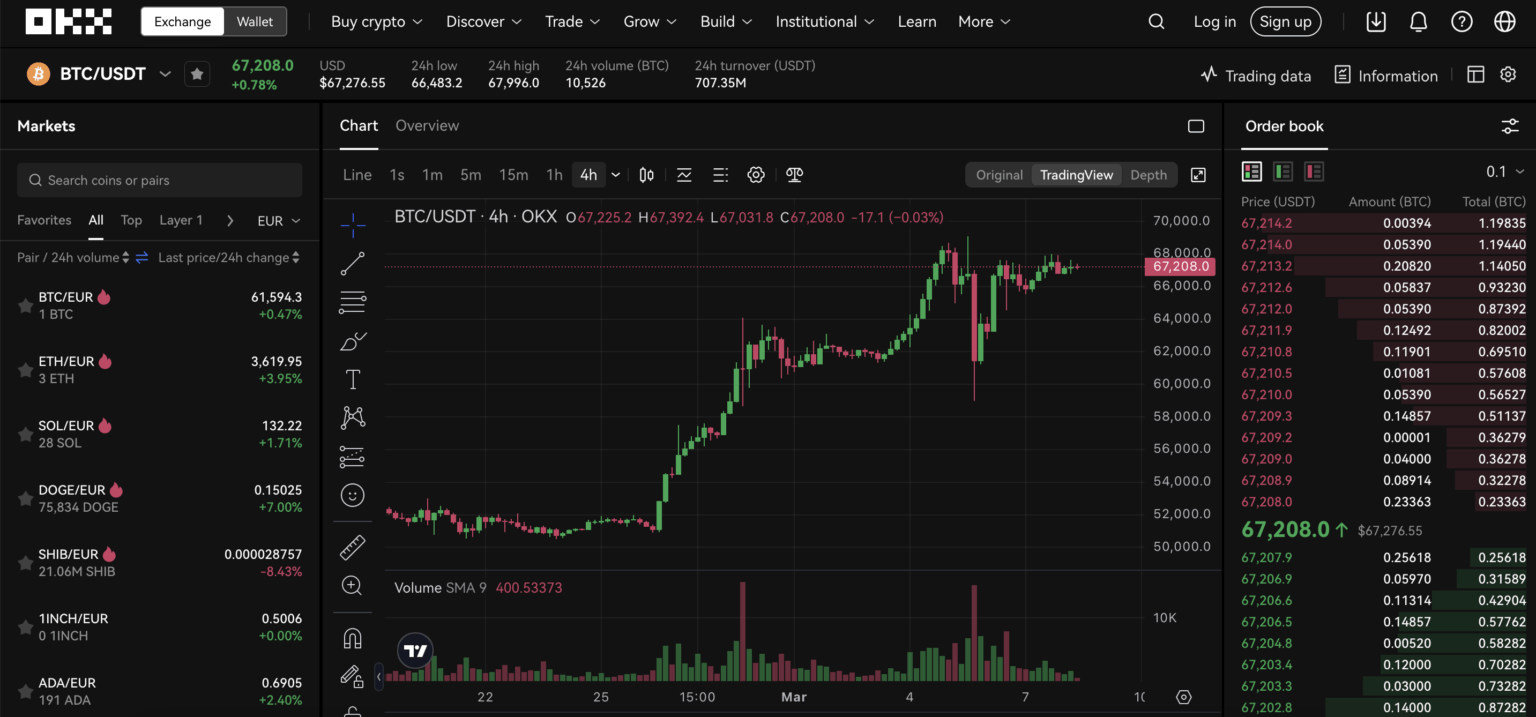
How OKX spot trading and margin mechanics actually work
Spot trading is straightforward at face value: you submit a market or limit order, and the exchange matches it against an order book. What matters beneath the surface are liquidity layers, order types, and settlement behavior. OKX supports over 300 assets and advanced TradingView charting — but liquidity is uneven. For major pairs like BTC/USD or ETH/USDT the order book is deep and slippage is small; for lower-volume tokens, the bid-ask spread can widen fast and market orders can get disastrous fills during rapid moves. A practical rule: when trading smaller-cap pairs, prefer limit orders sized below visible depth and check the last 24-hour volume before sizing a trade.
Margin trading on OKX lets you borrow to increase exposure, with up to 10x leverage in margin modes (isolated or cross). Mechanically, cross margin pools collateral across positions: it’s capital-efficient but exposes all positions to a shared liquidation trigger. Isolated margin confines liquidation risk to a single position at the cost of less efficient margin use. The key trade-off is therefore capital efficiency versus compartmentalization of risk. Margin interest accrues and maintenance margin thresholds matter — don’t trust a single leverage number alone; calculate how much adverse move your current collateral can tolerate before a margin call or forced close.
Futures, perpetuals, and real leverage mechanics
Many traders conflate “leverage” with borrowed size only. On OKX, perpetual swaps and quarterly futures introduce two additional layers: funding rate mechanics (for perpetuals) and settlement schedule (for quarterlies). Funding rates periodically move long-short incentives — if longs consistently pay shorts, the funding rate will be positive, nudging prices relative to spot. That matters because funding payments can erode returns on heavily leveraged directional bets even when the underlying price doesn’t move much.
Perpetuals can offer up to 125x nominal leverage on some assets, but that’s not an invitation to use max leverage. At high leverage, the liquidation boundary becomes very close to entry; small slippage, trading fees, or sudden price gaps can wipe positions. Also, exchanges widen margin requirements on volatile assets or during stressed market conditions, so what looks like 125x on the UI can be effectively lower when you try to open the position. For U.S. traders accustomed to regulated derivatives behavior, treat ultra-high leverage as a tail-risk lever rather than a day-to-day tool.
Staking, yield, and custody: choices and trade-offs
With OKX you can move between active trading and passive yield generation: flexible or fixed-term staking, DeFi yield farming, and auto-compounding options exist within the platform. Mechanically, staking locks tokens (or delegates them) to earn protocol rewards; fixed-term locks typically offer higher APYs but reduce liquidity and prevent quick redeployment into trading. Auto-compounding simplifies reinvestment but can mask realized reward timing and tax calculations — an important practical cost for U.S. taxpayers who must track realized income and basis.
Custody choices matter: centralized assets on OKX benefit from the exchange’s cold-storage practices — the platform keeps over 95% of assets in air-gapped, multisig cold wallets. That mitigates systemic hacking risk, but it does not remove user-level risks: phishing, compromised logins, and social-engineering attacks remain primary failure modes. Alternatively, the OKX non-custodial Web3 wallet gives you full key control (and full responsibility). The mental model is simple: custody = convenience + institutional-grade protections; self-custody = absolute control + absolute responsibility. Choose based on operational discipline, not ideology.
Myth-busting: three common misconceptions
Myth 1 — “Proof of Reserves means my funds are risk-free.” Correction: Proof of Reserves demonstrates on-chain backing at a snapshot level, improving transparency; it does not immunize users to market risk, custodial mismanagement, or off-chain operational failures. Think of PoR as a liquidity snapshot, not an insurance policy.
Myth 2 — “High leverage is just a multiplier of profits.” Correction: leverage multiplies losses and increases sensitivity to funding rates, slippage, and fee schedules. Beyond a mechanical multiplier, leverage raises the probability of cash-out events (liquidation). The proper heuristic: ask how much adverse price movement in percent would wipe your collateral, then choose leverage so that this buffer matches your risk appetite.
Myth 3 — “If a token is listed, it’s safe to trade at any time.” Correction: OKX periodically delists pairs (recently several spot pairs were removed as part of routine maintenance). Listings do not equal perpetual liquidity. Before trading, verify the 24-hour volumes and whether the pair has recently experienced suspension or delisting — smaller governance or meme coins are more likely to be removed, which can strand funds if you ignore exit routes.
Where the system breaks: limitations and real failure modes
Every platform operates with constraints. For OKX, three failure modes deserve attention. First, liquidity shortfall on niche pairs can produce enormous slippage and failed exits. Second, account-level security failures — weak 2FA, reused passwords, or credential leaks — remain the most common cause of loss despite robust cold storage. Third, when interacting with DeFi via the OKX DEX aggregator or external smart contracts, smart contract exploits and bridge risks are real: aggregator routing mitigates price and route inefficiencies but cannot eliminate underlying protocol risk.
Operationally, U.S. regulation affects user experience. KYC and AML checks are standard and necessary; they add friction for account opening and for asset recovery in rare disputes. If you value privacy, plan around that constraint: use on-chain, non-custodial options when appropriate and understand the tax and compliance trade-offs.
Decision-useful heuristics and a checklist for U.S. traders
Practical heuristics you can reuse: 1) For spot in liquid markets use market/limit mix: open with a small limit inside the book to test slippage. 2) For margin choose isolated for concentrated, speculative bets, cross for hedging multiple positions. 3) For futures never size a position whose liquidation threshold is within expected intraday volatility; compute worst-case slippage plus fees. 4) If using staking, align lock-up duration with your liquidity needs and tax planning horizon.
Pre-trade checklist: confirm 24h volume and order book depth; set 2FA and session protections; size position so that maximum acceptable drawdown < maintenance margin buffer; know the funding schedule for perpetuals; and for novel tokens check whether they’re at risk of delisting.
What to watch next — near-term signals and conditional scenarios
Follow these signals rather than headlines: funding rate trends (sustained positive or negative rates reveal market pressure), exchange custody snapshots (PoR updates), and delisting notices for small-cap tokens. If funding rates stay persistently skewed, expect short-term arbitrage strategies and funding-cost squeezes that affect carry trades. If the exchange increases margin requirements across assets, it signals higher tail-risk management and will reduce effective leverage for retail traders.
Conditionally, if regulatory pressure in the U.S. tightens around certain token classes or derivatives, expect more delistings or tighter onboarding rules; conversely, improvements in on-chain auditing or custodial transparency would reduce asymmetric trust costs and may attract larger institutional flows. These are scenarios — watch the regulatory and on-chain transparency indicators to update risk models.
FAQ
Do U.S. users need to complete KYC to trade on OKX?
Yes. Account creation requires Know Your Customer verification (government-issued ID plus a facial liveness check) before full access to trading and withdrawal features. Expect this to be non-negotiable because it’s driven by AML compliance rather than exchange preference.
Is using the OKX Web3 wallet safer than keeping assets on the exchange?
Safer in what sense? Self-custody via the OKX Web3 wallet or a hardware wallet gives you control of private keys and eliminates custodial counterparty risk, but it transfers all operational risk to you — seed phrase safety, malware on your device, and transaction mistakes. The exchange’s cold-storage approach reduces breach risk at the platform level but requires trusting the exchange’s operational integrity.
How should I think about using leverage on OKX futures?
Treat leverage as a sensitivity amplifier. Calculate how large a one- or two-standard-deviation intraday move would affect your margin; consider funding rate costs and potential widened spreads on liquidation. Use isolated margin for risky, stand-alone bets and keep leverage conservative unless you have stop-loss discipline and contingency liquidity.
What are the real costs of staking on OKX versus keeping tokens liquid for trading?
Staking yields passive income and compounding can increase effective returns, but locked staking reduces liquidity and the ability to respond to market moves. Consider the opportunity cost: staking APY must be compared to the expected return from active strategies net of fees and slippage. Also, tax timing differences mean staking rewards can complicate accounting in the U.S.
